
The Cinque Terre (La Spezia)
07-08-2025
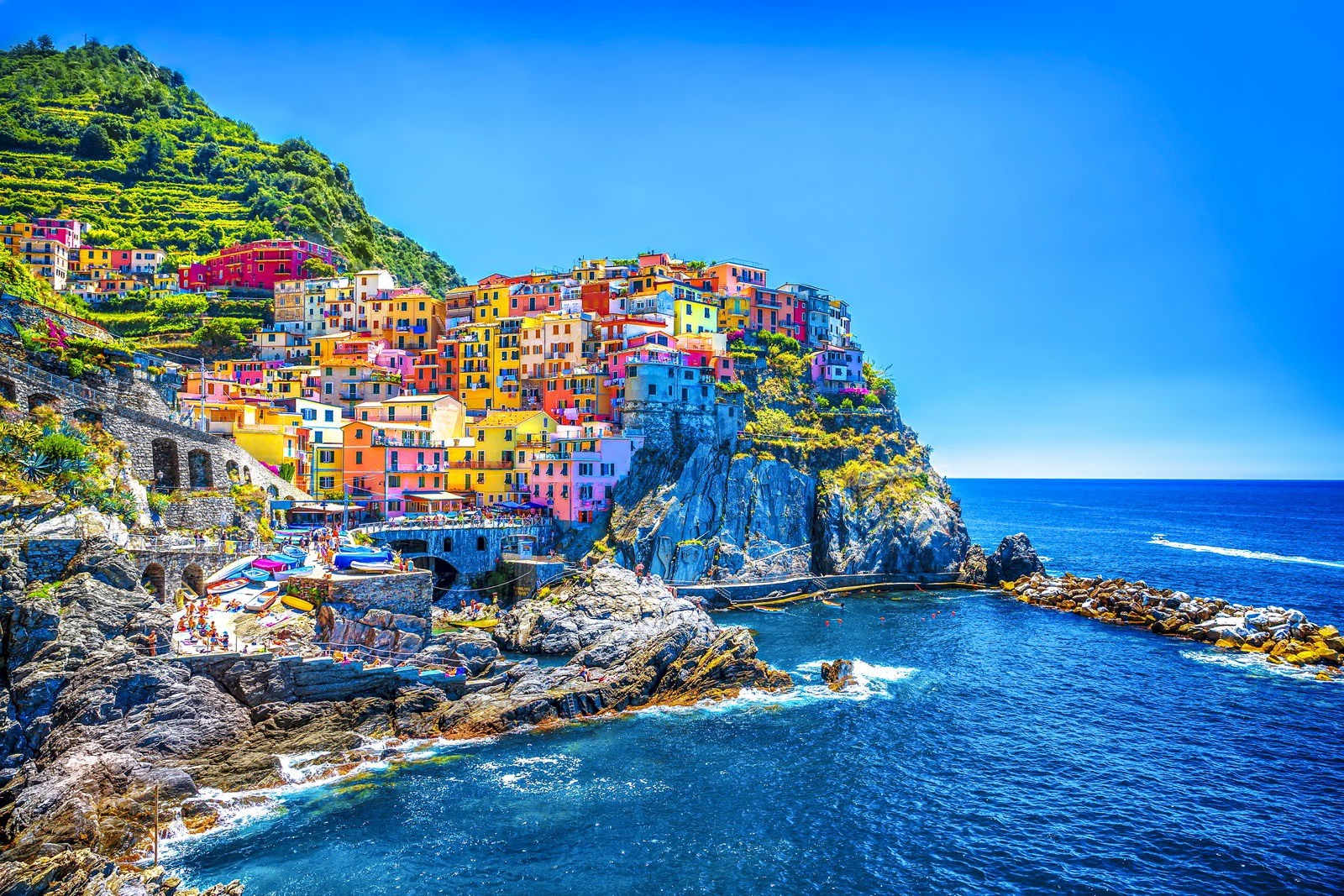 Eighteen kilometers of rocky coastline dotted with bays and beaches, overlooked by a chain of mountains running parallel to the coast. A diverse natural heritage with breathtaking views.
Five villages: Riomaggiore, Manarola, Corniglia, Vernazza, and Monterosso.
A Marine Protected Area and a National Park, the Cinque Terre were declared a UNESCO World Heritage Site in 1997.
Monterosso is the largest village in the Cinque Terre and boasts important monuments.
These include the 14th-century church of San Giovanni Battista, the Fieschi castle, and the monastery, whose church, dedicated to San Francesco,
contains priceless works of art.
In Fegina, noteworthy is Villa Montale, where the Nobel Prize winner for Literature stayed.
Vernazza: considered by many to be the most evocative of the Cinque Terre. The most important historical monument is Santa Margherita di Antiochia, a Romanesque-Genoese church dating back to the 13th century.
Corniglia, the only village in the Cinque Terre not directly on the sea, stands on a rocky promontory. The village's most important monument is the Gothic-Genoese church of San Pietro, built around 1350 on the ruins of an earlier building.
Manarola: A hamlet of Riomaggiore, Manarola is an urban gem, filled with typical Genoese-style tower houses. The hamlet's main monument is the Church of San Lorenzo, built in 1338 by the inhabitants of Manarola and Volastra.
Riomaggiore boasts monuments of great interest, including San Giovanni Battista, a three-nave church built in 1340, and the Oratory of Santa Maria Assunta, which houses a 15th-century triptych and a 14th-century wooden statue of the Madonna. Also noteworthy is the castle that dominates the historic center.
General info Cinque Terre
The Paths
How to get Cinque Terre
Sleep in Pisa and reach the Cinque Terre by train